A Waitress Secretly Fed a Lonely Boy Every Morning — Until Four Black SUVs Pulled Up Outside the Diner and Soldiers Walked In With a Letter That Made the Entire Town Fall Silent
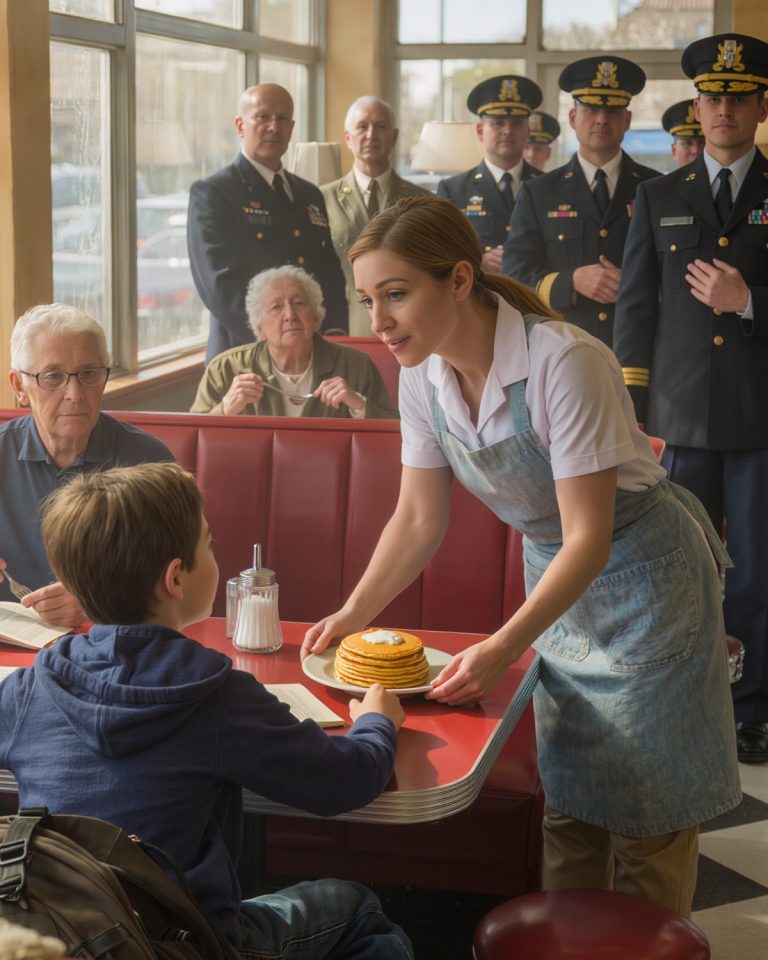

On the twenty-third day of the boy’s absence, something happened.
At 9:17 a.m., four black SUVs with government plates pulled into the parking lot. The diner fell silent. Uniformed men stepped out with discipline and precision. From the lead vehicle, a tall man in a decorated Army dress uniform entered, flanked by officers.
“Can I help you?” Mark asked nervously.
“We’re looking for a woman named Jenny,” the officer said, removing his cap.
“I’m Jenny,” she answered, setting down her coffee pot.
“My name is Colonel David Reeves, United States Army Special Forces.” He pulled an envelope from his pocket. “I’m here because of a promise made to one of my men.”
He paused, then added, “The boy you’ve been feeding—his name is Adam Thompson. His father was Master Sergeant James Thompson, one of the best soldiers under my command.”
Jenny’s breath caught.
“Is Adam alright?”
“He’s safe with his grandparents now,” the Colonel reassured her. “But for months, he came here every morning while his father was deployed. What Sergeant Thompson didn’t know was that his wife had left, and Adam was surviving alone. Too proud, too afraid to tell anyone.”
The Colonel’s voice softened. “Sergeant Thompson fell in Afghanistan two months ago. In his last letter, he wrote: If anything happens to me, please thank the woman at the diner who fed my son without asking questions. She didn’t just feed a child. She gave dignity to a soldier’s boy.”
Jenny’s hands trembled as she took the letter, tears streaming down her cheeks.
The Colonel saluted her, joined by every soldier present. Customers stood silently in respect. Jenny, the quiet waitress who had lived invisibly for so long, now stood at the center of honor.

The story spread quickly. The same people who had mocked her now praised her. Rosie’s Diner placed a flag and a plaque at Adam’s booth:
“Reserved for those who serve—and the families who wait.”
Veterans and service families began visiting, leaving notes, coins, and tokens of gratitude. Tips grew generous, often with messages: “Thank you for reminding us what matters.”
Jenny later received a letter in careful handwriting:
Dear Miss Jenny,
I didn’t know your name until that day. But every morning, you were the only person who looked at me like I wasn’t invisible. Dad always told me heroes wear uniforms. But I think sometimes they wear aprons too. Thank you for remembering me when I couldn’t explain why I was alone. I miss Dad. And sometimes, I miss your pancakes too.
Your friend,
Adam Thompson
Jenny framed the letter, keeping it quietly behind the counter.
see more on the next page